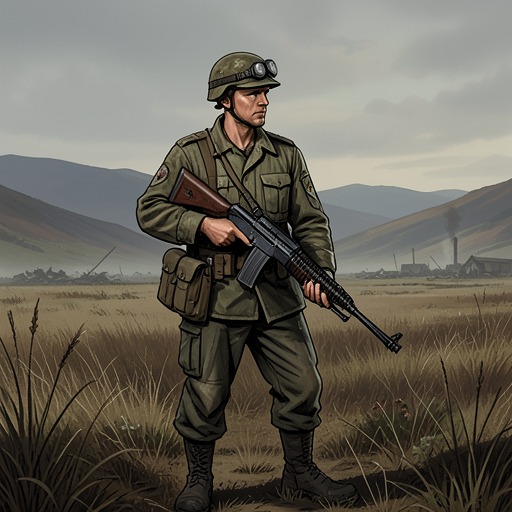
The 1847 Battle of Buena Vista
News of the WorldThe 1847 Battle of Buena Vista is both a combat episode in Jefferson Kyle Kidd’s military past and the setting for a defining act of storytelling. In the mountains above Monterrey in February 1847, Kidd fires at the smoke of hidden guns; later, as the Texas Rangers listen around a cold-night campfire, his recollections turn from battle tactics to the care soldiers owe one another. The episode links combat with the work he will later undertake: gathering and conveying news in the hope that knowledge can forestall violence.
Campaign and Combat
Kidd serves with Zachary Taylor’s forces in the high mountains above Monterrey, where soldiers have been fired on all the way from the Rio Grande. The attackers might be Mexican Army sharpshooters or Apaches; the men cannot tell which. Kidd is given a Model 1830 Springfield flintlock, a weapon he knows from having been raised with such arms. Lying in a wagon bed, he fires toward gunsmoke and hopes he has hit more than one concealed sniper, though the account does not confirm a hit.
The battle is fought in a landscape that makes the men’s circumstances plain: in the thin mountain air, smoke from their campfires rises straight up. The Rangers face an opponent they regard as strange and unlike themselves. Kidd describes the Mexican Army as formal and European in manner, while its barefoot mestizo privates are still made to wear neck stocks. The contrast gives the Rangers’ questions about their own conduct a setting of cultural and military distance, not merely a test of individual bravery.
The Rangers’ Questions
In the cold night after the fighting, the young Texas Rangers lounge against caissons and listen to Kidd out of courtesy to an older man. They are reckless and apparently fearless, but their questions expose a quieter concern: they want to compare their own conduct with that of earlier generations and decide whether their hardships and enemies measure up. They are not simply asking for a battle story; they are seeking a measure of what they themselves may be called upon to endure.
Kidd answers with memories of earlier service, carefully distinct from the Battle of Buena Vista. He recalls that the Creek and Choctaw used smoothbore guns, while his Georgia militia company brought its own rifles and fired minie balls. On the way to Pensacola, their wagons sank hub-deep in sand. Their captain was killed on the second day of the Battle of Horseshoe Bend; Kidd crawled out, dragged him under cover, and watched him die. He also remembers Andrew Jackson as fearless and nearly maniacal in combat. The Rangers’ unasked question about whether Kidd himself had been wounded leads him to disclose that a shot struck his hip without hitting bone. He did not notice the wound at the time and thinks a spoon may have hit him, because the Red Sticks had run out of ammunition and were firing whatever they had in their smoothbores.
A Lesson in Mutual Care
Kidd’s account does not end with the spectacle of survival or a claim to personal courage. With his trousers’ knees smoking by the fire and ink staining his hands, he gives the Rangers the practical counsel he has drawn from experience: a person can be hit without knowing it, and the man beside him can be hit as well; soldiers must take care of one another. The lesson shifts the emphasis from measuring one’s own toughness against an ancestor’s to recognizing how easily danger escapes notice and how much survival depends on attention to others.
The Rangers nod and consider his words while thinking about fighting in a strange land against a strange army. Their silence gives the advice room to settle; the encounter offers no assurance that the violence will cease, but it replaces bravado with a concrete obligation. Kidd’s authority here rests not on being untouched by battle but on having been wounded without realizing it, having tried to save a dying captain, and having learned that another person’s peril may be invisible.
From Battle Story to the Work of News
Alone later, as the mesquite fire dies, Kidd considers the intelligence reports and general press from which he has gathered facts about distant places, including struggles within the Mexican Army. He imagines dispensing such information to others: if people truly knew what was happening in the world, perhaps they would not take up arms. He sees himself as an aggregator of news whose work might help make the world more peaceful. The account identifies this conviction as an illusion that lasted from age forty-nine to sixty-five, preserving both its force and its eventual limits.
The episode therefore connects the immediate dangers of the campaign to Kidd’s later vocation without making the battle itself a simple conversion. Around the fire, the Rangers seek knowledge from a veteran; afterward, Kidd imagines extending that exchange beyond the camp, carrying facts from distant conflicts to people who might otherwise act in ignorance. Battle supplies the experience, testimony gives it to an audience, and the hope of preventing further violence becomes the purpose he attaches to the news.